Showing posts with label #MTBoSblog18. Show all posts

Tuesday, June 19, 2018

Raw Emotions

I'm a day late for #MTBoSBlog18, but considering that yesterday was the AP Reading Travel Day and I struggled to keep my eyes open, I am still counting this :)

I am feeling raw today. I don't know how else to explain it. I just spent a week with some of my dearest AP Stat friends, reflecting on the year, thinking of new strategies to use, and learning from each other, and to be honest, it made me wonder what has happened to me over the years.

This year's AP Stat test was a "math-y" test and I really didn't know what to expect going into the Reading. I know that in general, my students are not "math-y" students and over the years, I have de-emphasized a lot of the computations in favor of more conceptual understandings and this year that might come back to bite me. And then I started thinking back over the years...

Eighteen years ago, in the summer of 2000, I received a phone call the week before school started asking me if I would be willing to teach AP Stat. I had taught for 2 years, but nothing higher than Geometry and while I had taken a couple of stat classes in college, I wasn't sure about teaching the class. What a whirlwind of emotions I had that year! The AP Stat program was in its infancy and there was only one textbook out there at the time. I was clueless and lost. I stumbled my way through the year, many nights falling asleep with the textbook on my lap and gave "free days" more often than I'd like to admit because I did not know the material well enough to teach it. I diligently took notes on a legal pad, then transcribed them each day on an overhead projector for my students. I remember attending a 2 day training in early November 2000 and one of the sessions was on Type I/II Errors & Power and cried most of the way through the session because I was so lost. I was overwhelmed, exhausted, and had no idea what I was doing.

Somehow I made it through the year and even had some kids pass the exam! I spent the summer diving into every resource I could find, scouring used book stores for Statistics books, printing off idea after idea from the internet, and determined that year 2 would be better.

And it was. I fell in love with the course and attended every workshop I could find in order to deepen my own knowledge of the material.

Over the next few years, I focused more and more on having a student-centered classroom. I believed in the "sticky-ness" of activities, I used online applications to integrate technology, and the program continued to grow and thrive.

But this week, as I listened to the amazing teachers around me, I realized how much I had changed. I don't know exactly when this change occurred, but it did. I realized that while I still believe in the student-centered classroom, I don't know that my daily classroom practice illustrates that belief. I have regressed back to more lecture and more handouts and less activities. It's easy to find reasons excuses why this change has happened - larger class sizes, larger program, new preps, student changes - but ultimately, the responsibility lands on my shoulders. I allowed it to happen.

This realization about how much I have changed really bothers me. I was the young whipper-snapper, eager to change the world. I was the one that ran several teacher resource websites to share teaching ideas with the community. I was the progressive, student-centered, engaging teacher. But today, I just feel old and tired.

I'm not quite sure (yet) how to deal with this. I know that a good chunk of it is in my head. I know that I am a MUCH better teacher than I was at the beginning. I know that I have (way too many) resources at my fingertips. I know that I have some amazing pedagogical tools in my teacher tool-belt.

This year, we are adopting new textbooks. This change is somewhat scary because I have used my current textbook / author for at least 14 years, but I'm hoping the change will be the shock to the system that I need.

I still love teaching the course, but this summer I need to focus on how to channel that "inner me" that I know is still there.

Sunday, March 18, 2018

#MTBoSBlog18 - Spring Break

Spring Break is finally here..  YAY!

I have a pretty lengthy to-do list for this break.  Yesterday, I had planned to kick off spring break with some yard work, but all that I managed to get done was to buy a new bird feeder and a new rake.... and veg on the couch with a good book :)

This spring break is one that I've looked forward to for a few weeks because life has been CRAZY!

Back in mid-February, I stepped down as the building rep for our teacher association because I've finally learned to take things off my plate that don't make me happy.  I am teaching classes I adore and being the building rep meant meetings that I didn't enjoy.

Little did I know that two weeks later, issues in my state would come to a head and the world as I knew it would be upside down.  In two weeks, our legislature has a legal deadline to have a budget in place.  If they don't, our public schools have vowed to shut down.  This terrifies me because our state legislature has disregarded this April 1st deadline for years with no penalty and this year, the penalty will result in a statewide shutdown of our schools.

To be honest, I don't want to be at our state capital instead of with my students.  I don't want to lose valuable instructional time with one month before AP exams.  I don't want my students to be on an extended break with little supervision. 

But, I also don't want my students to continue to have underfunded classrooms.  My students deserve a highly qualified teacher in every classroom.  My students deserve to have smaller class sizes so they can form lasting bonds with their teachers.  My students deserve to feel safe at school.  My students deserve to have textbooks and supplies.  My students deserve all of this and so much more.

In the face of this crisis, our teachers have stepped up.  Plans are in place to feed over 4000 kids in our district on free & reduced lunches.  Plans are in place to find temporary work for our classified (hourly) staff.  So many plans are in place that I honestly hope and pray that we don't have to use.

This week, I will try to enjoy my break, to get outside and enjoy the fresh air and let go of the stressors of the past few weeks.  But the countdown clock is ticking and that scares the heck out of me.


Thursday, January 18, 2018

Feedback is useless.... Unless

All day today I had this feeling that I needed to blog and when I got home, I found out that Jennifer (@HHSmath) had started a new MTBoS blog initiative called #MTBoSblog18 where you blog *something* on the 18th of the month, every single month of 2018.  Now that's a blogging challenge that I think I might actually be able to do! :)

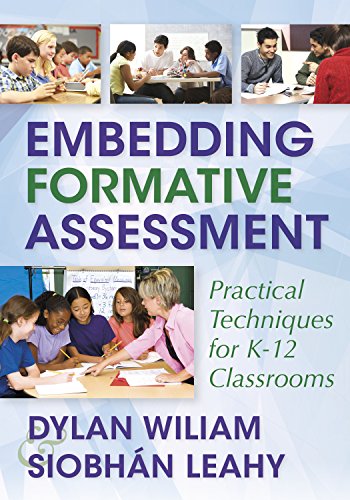
Over the past few weeks, @pamjwilson and I have been reading Embedding Formative Assessment by Wiliam and Leahy.  If you know me at all, you know I love a good #EduRead, but we've been taking this one pretty slow, with a chapter every 2 weeks or so to give us time to research and implement the strategies.  This past weekend was a long weekend for both of us, so we had arranged to read and chat over Chapter 5 - "Feedback that Moves Learning Forward"

Feedback is one of those difficult topics for me.  I know I need to give feedback, but the key is how to give *effective* feedback.  In the chapter, the authors actually share that a lot of the research on feedback isn't very valid due to issues such as a lack of a control group, varying experimental conditions, etc, but there were still some really good nuggets of information, such as this one...

The only thing that matters with feedback is the reaction of the recipient.  No matter how well designed, if the student doesn't act on it, then the feedback was a waste of time.
Wowzers!!!

In other words, feedback is useless UNLESS the student reacts to it and uses it to improve their learning.  I'll admit, that kind of hurts.  I mean, I spend time writing thoughtful comments and hints on their papers, but they aren't taking the same time to read and process those comments. 

But then the sucker punch came....

Don't give feedback unless you allocate class time for students to respond.  If it's worth your time to generate the feedback, it's worth taking instruction time to ensure students respond.
Bingo!!

Do I have systems in place for students to read and process my comments?  Have I set aside class time to model how to interpret and respond to my comments?  And key question - have I taught my students HOW to use the feedback as a tool to improve their learning?

Those were the thoughts rumbling about in my head while I was lesson planning on Monday.  Because of the holiday, this was a short week and I knew my students had a lab report due in Forensics on Tuesday.  Could I figure out a way to implement some of these feedback strategies to help my students write better lab reports?  I knew I wouldn't have time to read and give feedback in a timely manner on 30+ lab reports, so Plan B was born - we could do Peer Reviews! 

In most of our science classes, we use a CER format, which stands for Claims, Evidence, Reasoning.  In general, for Forensics, we use this format more when we have "Casefile" lab where the students have to make a Claim about who did (or didn't) commit the crime, and then back it up by citing their Evidence and then explaining their Reasoning on how they logically came to that conclusion and how they eliminated the other suspects.

We gave them a few minutes at the beginning of class to finish up their CER and refresh on the Casefile from the previous Friday.  Then, we asked them to exchange with another student that was NOT in their lab group.  The student reviewer was to read the CER and provide feedback in terms of a "stars and wishes" - what the original author had done well and what could be improved.  During this time, they were not to talk at all, just read and write.  Then, they returned the paper to the original owner and talked over the feedback and asking clarifying questions.  Finally, we gave the students time to use the peer feedback to revise their CER before turning it in. 

While I have some other strategies from this chapter that I want to try, my biggest take-away is that I need to have a systemic approach to feedback.  I need to spend some time thinking about how to teach my students to read the feedback, but more importantly, how to USE the feedback.  I have to build time into my classes for students to receive feedback and actually implement that feedback to improve their learning.