Showing posts with label #eduread. Show all posts

Sunday, November 5, 2023

Teaching Math with Heart and Soul - an NCTM Reflection

Last week, I had the opportunity to visit Washington, DC to attend the NCTM annual conference.  I'm going to blog through some of the sessions I attended to help me process and reflect.

My first session at NCTM was the perfect start to the conference!  I had heard of Dr. Timothy Kanold multiple times and had read some of his work on PLCs, but this session focused mostly on his books Heart! and Soul!.  It also touched a bit on his book about Educator Wellness and all three books quickly went on my TBR list!  I have started reading Heart!, so I'm sure I'll be updating this with take-aways from that book as well.  (Anyone want to #eduread it with me?)

Dr. Kanold started his session talking about the importance of gratitude and shared about his family tradition of asking "What was the best part of today?" around the dinner table.  He asked us to send a text of gratitude to someone who made it possible for us to be at NCTM.  While he was talking about this, I thought of Rebecka Peterson, our National Teacher of the Year, and how she credits the One Good Thing blog for being such an instrumental part of her teaching journey.  Funny enough, Rebecka walked into the session a few minutes later, so obviously Dr. Kanold's session blurb resonated with her as well!

Here are some of my jotted notes from Dr. Kanold's session:

  • Can we fully give ourselves to our work and not get lost?  (Answer - Yes, but you do have to take care of yourself!)
  • Presenting ourselves in a high positive happiness state affects how well students learn in our classes
  • How can we embrace joy amidst the daily chaos?
  • Joyful people are hope providers
  • Compassion - caring / support / love... emotionally mourn the setbacks of others and cheer on their victories
  • What evidence can you show that your school has a compassionate culture?
  • Acts of compassion helps us sustain.
  • What acts of compassion would we see at your school?  
  • An antidote to burnout is self-compassion
  • Residue of self-compassion is joy
  • There is power in journaling over verbal processing... journaling dissipates the emotion
Then Dr. Kanold shared with us about the Energy States.  (The math teacher in me doesn't like how the quadrants are numbered, but anyway....)

In the classroom, we would like to be in Quadrant 1, but there is a natural drive to Quadrant 3.  He said that "Internal Balance is the key to well-being"

How do we achieve that internal balance?

KEY - Q2 time time is required daily!! 

Some more jottings about this idea:
  • Be intentional about time for solitude (referenced Sherry Turkle - purposeful solitude with an embraced silence)
  • Give your brain time to be quiet
  • Daily quietude required
(Side note - I LOVED this idea.... I need that quiet time, not just as an introvert, but now I know it helps me stay more balanced!)

Dr. Kanold ended his session with some tips on self care and the Wellness Framework, which had some really great tips, including Drink the Stupid Water.  I am the world's worst about drinking water, but I am making an renewed effort after his session.  

He also talked about the importance of movement and not comparing yourself to others because if you are moving, it counts.  His last tip was about the importance of sleep and gave us some suggestions on how to get the best rest.

My biggest take-aways:
  • Quiet time is required to keep us in a positive frame of mind.  Go for that walk, sit outside, read the book, meditate, whatever it is that gives you time to find peace every day.
  • Drink the Stupid Water - hydration is so important and if you get thirsty, it's already too late and your body is dehydrated.  Start your day with a bottle of water beside your bed.
  • You are harder on yourself than you should be and we are not as kind to ourselves as we are to others.  Give yourself grace
  • Find moments of joy and gratitude in every day


Thursday, June 8, 2023

Shifting our Thinking

Ugh - how is it that another 6 months has gone by since I last posted?  Often, I will have an idea for a post, jot it down, then by the time I get home, the idea I had that I thought sounded good no longer has any appeal.

But, summer is here and it's a time to reflect, grow, and learn again!  

Last week, I was excited to be involved in a workshop in my area called Exponential Growth.  It is co-sponsored by one of our local universities and our regional STEM alliance.  They have several different workshops, but I was in one for instructional leaders (math coaches, etc).  The workshop was JUST what I needed to jump-start my summer planning and I'm excited to work with my cohort over the next year.

During the workshop, we looked at growth vs fixed mindset and looked at book Principles to Action with regard to what we would like to see in a math classroom and the Effective Teaching Practices.  We looked at productive and unproductive beliefs and sorted them into our ideal classroom and our less than ideal classroom.

We also looked at a variety of tasks and how many of them could be used across the grade level bands.  One of my favorites was this fish pond task...

Our instructor gave us a handful of these colored goldfish (found on Amazon, of course!) and several fish pond mats.  I didn't end up taking a photo until our last mat, which was a make your own problem.  As a result, it's kind of hard to see the point of the mats, so bear with me...

On the first mat, the little "bridges" between the ponds had numbers showing the total of the fishes between the two.  For example, the number 7 was between the purple / orange.  The number 9 was between the purple / blue, and the number 8 was between the orange / blue.  It was our job to figure out how many goldfish were in each pond.  As teachers, we all knew that we could do this with a system of equations or a matrix, but to start out, we just played with the fish and thought about what would happen if we took one of the purples away or added another orange.  Our group was given a variety of mats, from basic to more complex and finished with the one shown on making our own problem.  It was a great way to look at a system from a more concrete standpoint and would be a fabulous low-entry task for a variety of levels.  Our instructor mentioned that she would never teach systems again without starting with a task like this and move from the concrete to the abstract.

I was so inspired after the first day, that I decided to start my summer reading!  I quickly picked up this book from Cathy Seeley as my first summer #EduRead.  I had read one of Seeley's books before, but this book seemed to tie into the workshop perfectly as it was aimed more at admin / instructional coaches in building a great math team.  In the book, Seeley talks about the importance of carefully selected tasks and using a structure she called Upside Down Teaching.

This sent me down another rabbit trail on Upside Down Teaching, which Seeley also calls the "I-We-You" structure.  The idea is to start with a task for students to tackle first, then follow up with classroom discourse and the overall connections.  For me, this also ties in to my personal goal of engaging students with a task or activity that helps to make the entire process more "sticky" with regard to learning.  

What probably bothered me the most about this Upside Down Teaching model was the section in the article about choosing tasks.  I completely agree that choosing good tasks is key and I think many math teachers would agree about the difficulty of choosing just the right task for the lesson, but what floored me is that in Seeley's article, the description of what makes a worthwhile task is from 1991!!  For OVER 30 years, we have known about the importance of quality tasks, but we still don't see that displayed on a regular basis in many classrooms, including my own!  

What I appreciated most about this rabbit hole was that it allowed me to think about my goals for this next year and to make a commitment to bringing more quality tasks into my classroom and to explore this Upside Down model and how it would apply to my classroom.


Saturday, August 8, 2020

#MTBoSBlaugust - WSQ and Google Forms


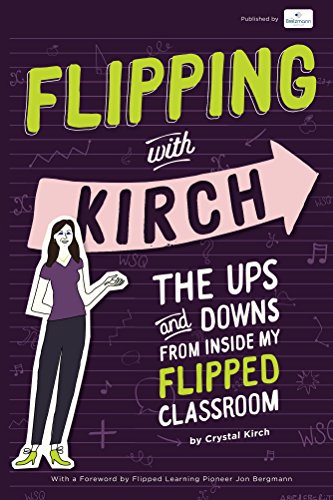
Whew - what a day!  We had our first Math Teacher Collaboration today and it was just amazing!  I learned so much and my mind is struggling to settle down with ideas tonight.  I know there will be some blog posts coming in the next few days, but one of the topics that I've been working on this summer is the idea of the Flipped Classroom.  We did an #EduRead  book chat on Twitter starting in late June over the book Flipping with Kirch, which is about Crystal Kirch's journey to a Flipped Classroom.  If you are interested in learning more about the Flipped Classroom, I highly recommend reading this book as it is a very quick read with a ton of practical tips and hints for implementing this model.  

To be honest, I've thought about the flipped classroom many times over the years, but other issues got in the way - equity of tech access, thoughts and feelings on homework, all of the housekeeping details with accountability, and the list goes on and on.  But in the COVID world that we find ourselves, the Flipped Model seemed to be the best model for balancing at home vs in-person instruction, especially as classrooms and groups of students might be asked to quarantine.

One of the ideas that Crystal shares in the book is the idea of the WSQ (pronounced Whisk), which stands for Watch - Summary - Question.  I love this idea on multiple levels - it allows for accountability, it allows for the teacher to peek into the student thinking, it allows for an element of "notes".  However, in this distance learning world, I've been playing with the idea of having kids keep a paper notebook vs a digital record and how to balance the two.  I know I want them to have a resource that they can use in future classes, a resource to take with them.  But I do want a way to monitor their thinking as well, see the questions they have, read their summaries, etc.  So how do I keep both of these in balance?  I've looked at EdPuzzle for the Watch, which allows for formative questions throughout and I like that idea.  The EdPuzzle analytics allows me to see who has watched the video, how many times, see the answers to their questions, etc.  I've thought about my beloved Desmos.  In the book, Crystal mentions using Google Forms, so I played with that a bit yesterday...

There are parts of Google Forms I like - I love the spreadsheet feature that lets me look at their questions.  If I do a formative question, I can use conditional formating or make it a quiz, but then I vaguely remembering seeing an option to email a copy to yourself.  In the Google Form settings, you can change it to include "Response Receipts", which allows you to email the responses to the person.

I'm thinking this might be a way to bridge the personal copy and the teacher copy... Students can watch the video, answer any formative questions, write their summary, ask the questions, then when they submit, the teacher will see the responses AND the student will have a copy in their email.  Set up a label and now they are all nicely sorted into a GMail folder.

So help me poke holes in this idea... What works?  What doesn't?  Pam suggested having an option to do a photo upload for doing their summary / question on paper and I like that too.  Maybe a branching form?  

Sorry for the lack of organization of this post - it's still a work in progress, my brain is mush after all day on Zoom, and the new Blogger is not playing nicely with the images and formatting, but I'm too tired to fight that battle tonight.. :)


Tuesday, August 6, 2019

#MTBoSBlaugust - Do No Harm


This month, I am participating in a blogging challenge called #MTBoSBlaugust.  To read posts from other participants, click on the logo above.


Last week, my school hosted a math conference.  Over the course of the day, I had many people comment about how nice it was to have math specific PD and the need for it.  It took me back to earlier this summer when I finally had time to dig into one of the books high on my "to-be-read" list - Necessary Conditions by Geoff Krall.

You can preview (or purchase) the book on the Stenhouse website by clicking here

In Chapter 1 of Necessary Conditions, Geoff tells the story of Damien, a high school senior with big plans.  From the story, you get the sense Damien is a great kid with a passion to help his community, a kid not unlike many of the kids we see each day in our classrooms.  As Geoff shares the conversation he had with Damien, you get a feel that Damien's math education was fine, although not very cohesive, and then you get to this quote...
"For an education environment that strives to standardize instruction and student outcomes, there is remarkably little consensus about what a quality secondary math classroom looks like."

Whoa... did that just hit you in the gut like it did me?  As I was reading, I quickly scribbled this quote down in my reading notebook and put a mark by it to discuss with my Secondary Math coordinator.  What *does* a quality math class look like?  sound like?  feel like?

I teach at a large suburban high school and have been there for 20 years.  I know that at the district level, there have been those discussions about quality instruction, but not as much on the site / department level.  As I read this book, I kept coming back to this question and Damien's story.

Further in Chapter 1, you see these statements:
"What's particularly troubling is that none of Damien's high school teachers were derelicit in their duty. ... But with no common understanding of what high-quality math instruction looks like or what students are experiencing in their classrooms, gaps in learning and in attitudes toward math will continue to widen."
"Adding urgency and magnifying the issue is that math is often the biggest - sometimes the only - hurdle to an otherwise prosperous educational career.  The lack of a sufficient math background can be the death knell for students once they reach university."

Honestly, this is frightening.  Last week, I was at a Career Readiness workshop and Damien again came back to my mind.  Our courses aren't just a ticket punch on the way to adult life.   Our courses can be significant barriers to our students as they approach their post-secondary careers.  What have I done to contribute to that barrier?  What have I done to actively attempt to break down that barrier?  What can I do going forward to advocate for students like Damien?

I think about the Hippocratic Oath that doctors take - the idea to ethically treat patients and do no harm.  I think about Damien and his teachers; I think about my own past students.  There was no intention to harm, but has harm happened anyway?  By not having a cohesive definition of a quality math classroom, how many students have hit the barrier to future success?  How many students could have made powerful mathematical connections instead of seeing the courses, units, and chapters as these disconnected requirements that they just have to get through.  How many students (or even teachers) have been deprived of discovering the joy and beauty of mathematics?

Two weeks from today, I will meet my students.  I will again have an opportunity to shape their thoughts on math.  I have the power to help or to hinder.

And that scares me.

Friday, June 21, 2019

The Importance of Closure

The best part of summertime is having time to read!  The worst part of summertime is that I have to wait to put new ideas into action. :)

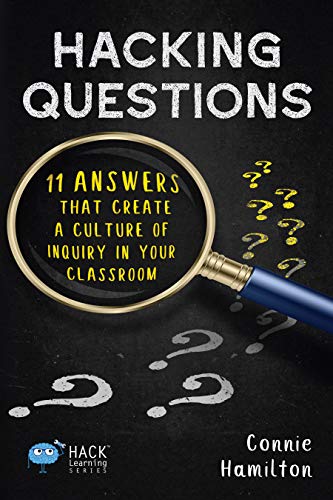
My first #EduRead of the summer was Hacking Questions by Connie Hamilton and I must say that it did not disappoint at all!  This book was extremely affordable on Kindle and it was worth every penny.  I had originally heard of the Hacking series a few summers back from a podcast, but this was the first one I had read.  Each of the "hacks" is presented in a clear manner, with easy-to-implement strategies, suggestions for overcoming challenges, and a classroom vignette to illustrate the hack in action.  While there were several "hacks" that I plan to revisit when August comes, the chapter that struck me the most was Hack #3 - Punctuate Your Learning Time

For most of us, time is the enemy - especially in the classroom.  There's never enough time to do it all.  From lesson prep to grading to the actual teaching, every single minute seems to be accounted for.  As a result, many of us (including me) see the minute hand inching toward bell time and have to make a decision of what to do - finish up this last little bit, trying to ekk out every possible second or wrap up and do a closure activity?  Way too many times, I have chosen the former option and neglected to properly close out our learning time.

But, after reading this Hack, I am committed to doing a better job this year.  The author shares this  analogy that really struck home for me on the importance of closure:
"Relate it to your own daily routine.  Don't you feel frazzled when you have to leave school quickly and do not have time to process the day and think about tomorrow?  We naturally build in closure to our day, even if we did not finish what we set out to accomplish."  
I honestly had never related closure in the classroom with my personal closure of the day, but it makes perfect sense!  When something happens and I'm rushing around after school to get to a meeting or whatever, I just feel "off".  What if my students feel the same way at the end of our lessons?  Have I given them the processing time they need to effectively summarize their learning and move the day out of working memory?  Have I created problems for myself and other teachers in the future by not giving students time to make necessary connections?

After reading this Hack, I am more committed to intentionally creating closure opportunities in my classroom to "pull the lesson together, assess the learning, and help to set it in the students' minds."  This may be through exit tickets at the end of class or other processing strategies throughout the lesson, but either way, I must make the choice to properly punctuate my learning time because according to the author:
"...it is crucial that we use the limited time to maximize learning.  Five more minutes of engaging in a task are not as likely to impact students as five minutes of reflection."
I don't know about you, but that's powerful...

For more information on this book and its author, includings a ton of free printables for the classroom, visit the Hacking Questions website!

What are your favorite closure strategies / prompts?

Tuesday, September 4, 2018

Teaching Diary

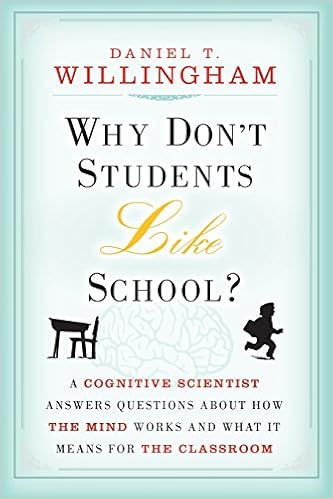
This summer, one of my #eduread books was Why Don't Students Like School by Daniel Willingham.

I really got a lot out of this book and it will definitely be on my "revisit" list as I loved the classroom implications for each chapter!

But the last chapter is the one that really got me personally.

The final chapter in the book is titled "What About My Mind?" and differs from the rest of the chapters in the book as it focuses on how we as teachers can grow professionally and continue to learn throughout our career.  Some of the suggestions are things I've heard of before, such as video-taping yourself or inviting observation, such as the Observe Me movement, but one suggestion really stuck with me - a Teaching Diary.

I'm a paper person in general - I love writing my lesson plans down, I brainstorm on paper, etc, but a Diary?  I have never (successfully) kept a diary in my life!  Heck, my childhood diary still has more than half of its pages empty and I wrote in it off and on from age 7 to ???.  What makes me think I can keep up with a Teaching Diary?

Well - maybe I can't, but I'm at least going to try :)

I purchased a super cute composition notebook, glued a table of contents and various calendars into it and am determined that it will go with me to (most) meetings as a place to record ideas, glue in handouts, etc.

But the biggest benefit - hopefully - will be the weekly recap pages. In the book, Willingham says...
"... don’t expect that you will really remember how well a lesson plan worked a year later. Whether a lesson goes brilliantly well or down in flames, we tend to think at the time that we will never forget what happened; but the ravages of memory can surprise us, so write it down."
So I decided to try it.  In my pretty mew notebook, I developed a weekly recap page where I can jot myself notes about how each day went, the pros / cons / changes for next year. 

I can't promise that I'll keep up with it, but baby steps, right? :)

Do you keep a teaching diary?  How do you have yours set up?

Monday, September 3, 2018

Homework.... Again

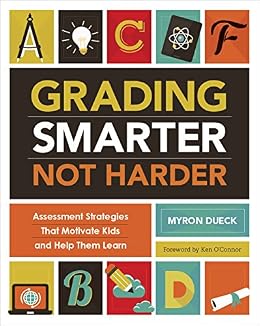
This summer, I posted a time or two about my Homework plan, based on the book Grading Smarter, Not Harder.  Now that school is in session and I've had some time to process my posts, I wanted to revisit this topic as a Blaugust post. Sadly, I missed the August deadline by a few days, but yesterday, I saw a tweet about homework and it reminded me...

Back this summer, as I was reading Grading Smarter, I mentioned the fact that I felt many students were not doing their homework because of a lack of accountability.  They didn't think I was looking at it, so therefore, it didn't matter if they did it or not.  I knew I wanted to develop a procedure that would add in the accountability that I was currently missing  without adding in a huge amount of work for me or my students.  


Part of my homework plan was to be very intentional in the problems I chose.  As a result, I decided that homework would never be more than 10 questions lost and preferably, at least 3 of those would be from previous knowledge.  In the image above, the half-sheet at the right is their HW / Exit Ticket sheet that stays in their table folders throughout the week.  As we grade our HW, the students code it using the codes on the left, based on a post from @pamjwilson.

After we have gone over the HW, students do a short reflection.  Here are some examples from the previous couple of weeks:


Overall, I really love this new way to communicate daily with my students, identify their struggles, and be able to see which problems we need to go over further before an assessment.  Students that in the past would have been too embarrassed or shy to ask a question are willing to ask it in the written form and that alone makes it worth it to me!


Thursday, August 2, 2018

#BecomingMath - Thoughts on Collaboration


This month, I'm participating in a blog challenge called Blaugust.  To see the list of participating blogs, click on the logo above. I would encourage to you please cheer on our participants with either a tweet or a comment on their blog during this month. It can be hard to blog on a daily (or even regular) schedule! :)  If you would like to join the blogging challenge, you can still sign-up anytime!


Tonight is our final book chat on Tracy Zager's Becoming the Math Teacher You Wish You'd Had.

When I first picked up this book, I'll admit that I was a bit overwhelmed by its size.  My typical edu-reads are not 350+ pages long, so its taken me a bit longer than normal to read this one.  In general, the book is focused toward elementary teachers, but there are a lot of take-aways for secondary teachers as well.  I've had a couple of chapters really blow me away and a few others that I skimmed more than read because it just wasn't as engaging to me.  But, overall, this book will be on my recommendation list and will be one that I revisit over the years to try another strategy in my quest to be a better teacher.

We intentionally set the reading schedule so that we would finish the book around the time that most people are returning to school and I'm so glad we did because in the last chapters, I found some really great takeaways that have caused me to do quite a bit of pondering.

Chapter 12 is titled "Mathematicians Work Together and Alone".  This was an important chapter for me because my classroom is set up in tables but I don't always leverage it well.  The physical layout is due to a couple of reasons - I believe in the power of collaboration and tables allows for easier movement around the classroom, especially when its packed with 30+ adult bodies and backpacks.

However, there are some limitations to this layout and one that has frustrated me over the years - students start to rely too much on the power of the group and end up with an inaccurate reading of how well they have personally grasped the content.

My biggest take-aways from the chapter are:

  • "Teach students how, why, and whether to interact."
    Wow... So simple, yet so difficult.  Because I teach high school, I often assume that students have some knowledge of how to work with their peers, but if that were true, my frustrations would be taken care of, right?  I really like the addition of "whether" here, because there's a time and a place for groups vs independent work.  In my classroom, I need to work on better defining my expectations for individual work and to help my students develop a better sense of when collaboration is valuable versus over-reliance on others.
  • "Students need to learn how to ask for what they need from one another and to be what they need for each other."
    I've never really thought about this, but it makes so much sense.  As an adult, I am comfortable saying to my spouse or to a coworker, "Hey, can I talk this through with you to get some feedback?"  Or even online, we do this all the time via our Twitter PLN, but I need to explicitly teach my students how to monitor and do "self-care" for themselves academically.  Some suggestions given in the book are to teach your students that it's okay to say things like "Hang on a minute - I need to wrap my head around this on my own first." or "I'm stuck... are you at a place where we can discuss this problem?"  I really love this, but do need to work on how to develop this culture in my classroom.
  • "Students should spend most of their math time gathered around rich problems, flowing naturally among thoughtful dialogue, periods of quiet thinking, and bursts of active chatter as they make sense of mathematics."
    If someone were to ask me to describe my ideal dream classroom environment, I could not have phrased it any better than Zager did in the quote above.  However, while it may be my ideal, it's not where my classroom actually is and I'm not quite sure how to get it there - YET.  I have some ideas to implement this year to move me closer to that ideal, which I'll be blogging about this month.  I have some of the elements in place - whiteboarding, groups, etc, but I need to work on implementing rich problems and developing guidelines for productive discussions (thankfully, I have a plan for both, just need to implement!)
  • "New ideas only influence students' work if students resume working after being exposed to the new idea.  Otherwise, those fleeting thoughts won't penetrate."
    Honestly, this is probably one of the most profound statements I've read in a very long time.  It applies to everything - discussions, feedback, practice - everything!  I even notice it in my own professional life - I often read something or engage in a twitter conversation about a great idea, but if I don't stop to process it and intentionally *implement* the idea, then no matter how great of an idea, it will be lost in the netherworld forever.  I need to be very intentional about this - I have to give students time to ACT on feedback, to use and internalize and apply what they have learned.

Friday, July 20, 2018

More Thoughts on HW

Y'all - I know I posted last week about Grading Smarter, Not Harder, but to be honest, you can expect several more posts before it's all said and done!  This book might just end up on my Top 10 favorites list because every chapter so far has produced some really deep thoughts for me about grading and assessment.

I've had this book sitting on my Kindle for a while now but just hadn't gotten around to reading it.  I've read so many books on assessment and grading and didn't know that one more would make a difference.

But, this book is different.  It's not about Standards Based Grading so much as it is about what do you believe a grade means and how can we communicate that to our students?  It's about opening up lines of communication between the stakeholders (teachers, students, and parents) and being very transparent by letting our students know what they know.  It's about documentation of learning and helping students make the connections between the day to day classroom activities and the resultant assessment scores.  All in all, it's what I really needed to read this year to help me figure out some of the difficulties I've had in really helping my students self-analyze where they are, where they are going, and how to bridge that gap.

In last week's blog post, I was brainstorming a homework check sheet and here was my thought at the time:


Today, I finally sat down to start trying to piece this together and here's what I've come up with so far:

It's a half-sheet horizontal and because I see my students 4 times a week, it has 2 days on front and 2 days on back, split into the HW/Reflection and Exit Ticket areas.  The Exit Ticket should be self-explanatory, so here's what I'm thinking on the top part...

First off, I had already planned to limit my homework to no more than 10 practice problems per night, with at least 2 or 3 of those being from previous knowledge.  At the beginning of class, students will mark which problems they fully attempted and as we "grade" the HW, they will code the boxes (see Pam's blog post here) to indicate which problems they got correct, incorrect, struggled on, etc.  In the space below, I can either ask a reflection question over the HW or this can be the space for students to ask me private questions regarding the HW.  This is also the space that I can use to "stamp" the HW if needed.  Since these forms stay in their table folders, I'll be able to look at them and monitor them for any potential issues.

If you want a copy of the file or want to play around with it, you can download it here.
Fonts used:  KG Love Somebody and KG Second Chance Solid

So help me, MTBoS.... what needs to be changed?  How can I make it better?  What are your thoughts?


Thursday, July 12, 2018

Ramblings on Homework and Grading

There are a lot of thoughts rumbling about in my head today and a lot of them have to do with my latest summer #EduRead - Grading Smarter, Not Harder.

A few weeks ago, prior to the AP Reading, @mathteacher24 posted something about this book on Twitter and it reminded me that I had it in my to-be read pile, so why not add it to my summer reading list? :)

Many years ago, I was unhappy with how my class was structured grading wise and started exploring Standards Based Grading (SBG).  For the past 8 years, I've used SBG and been fairly happy with it, but throughout the years, I've become more and more frustrated with some of its shortcomings, so I knew I wanted to do some thinking about assessment this summer.

Last night was our first chat session over Chapter 1 and I really don't have a ton of insights from that chapter because I agreed with almost everything the author said.  I completely agree that grades should be a reflection of the learning objectives and not student behavior.  One part that struck me though was the idea regarding a zero for missing work.  I've never been one to penalize late work but what do you do with students who haven't turned in missing assignments or taken a quiz when the time comes to turn in semester grades?  In the past, I've always changed those to zeros but according to the author, that's the same as a late work penalty because had the student turned in that assignment, the likelihood of earning a zero is probably small and therefore the grade is not an accurate measure of student learning.  One strategy the author suggests is a policy I remember from years ago called ZAP - Zeros Aren't Permitted.  I haven't thought of that strategy in years, so I need to go back and do some refresher research on it.

BUT - then, this morning, I decided to go ahead and read Chapter 2 on Homework.  Oh wow... I definitely need to do some thinking on this one!

I'm pretty sure that Homework is the bane of my existence.  I've tried something new pretty much every year and I'm never fully happy with it.  I haven't graded homework in years, because I believe that homework should be about practice.  Add in other equity issues such as the outside of class difficulties and the fact that not every student needs the same amount of practice and I am still firmly in the "no grade" category.

However - I do feel that there should be an accountability system in place and I've been battling how to handle this all summer.  Over the past few years with SBG, I've noticed fewer and fewer students are doing the assigned practice problems and I take a lot of responsibility for that.  I have done a poor job of connecting practice and assessment and helping students build the necessary study skills to help them find success.  I take it for granted that students know that doing their HW should help them to be more successful on the assessments.  Because I don't grade the HW, nor do I hold students accountable for doing the HW, I think many students have taken that to mean that I don't value the HW as a learning tool, which is far from the truth. 

So while reading Chapter 2, I run across Strategy #1 of In-Class Quizzing, which has several bullet points talking about students tracking their own progress and teachers using homework-completion data as formative assessment, which led me to throw down this tweet:


Here's my current thought...
  • In my table folders, students already have a weekly exit ticket sheet that they are used to.  Sometimes this is a question to be worked for feedback, sometimes it is a written response, etc.  What if I modified this form to have 2 spots per day - a HW reflection and an exit ticket area?
  • The HW reflection would be part of their warmup time and students would self-assess on a Likert scale how much of the HW they had attempted and a couple of short reflection questions, something to potentially open up a personal discussion about problems they attempted, where they struggled, etc. If they didn't do it, they could put in why as well - it's not punitive, just for documentation
  • Off to the side of the paper, I would have an area to write comments or go around to spot-check / stamp their self-assessment, etc.  

Anything else that you can think of???

As I mentioned above, I've not done a great job of connecting practice and assessment and the next strategy in Ch 2 talks about a Homework Profile.  (You can read more about it over at ASCD)

Pretty much I envision a test / quiz reflection form that looks something like this:


Corresponding to each box would be the descriptors from the ASCD link.  I'm thinking this might be a great post-quiz reflection tool to help my students really see the value of WHY they should do the practice.  Also on this form might be an error analysis to help them make a study plan which leads into the reassessments. 

If you've made it this far, thanks for reading :)  I just had to get some thoughts down on "paper" and as always, I value your comments.  Please feel free to push back in the comments here or catch me on Twitter.  

Wednesday, June 20, 2018

Learning, Thinking, Doing

For me, one of the best parts of summer is the time I have to read.  I know I will never get to all of the books on my "to-be-read pile", but I make an effort each summer to at least put a dent in the stack.  Of course, this is more difficult when I keep adding to the stack....

But I digress. :)

One of this year's book choices is Why Don't Students Like School by Daniel Willingham and while I'm less than halfway through the book, it already has the potential to be a game changer in my classroom.  Willingham is a cognitive psychologist and the style of the book is very similar to Make It Stick, another book that I highly recommend.  One thing I really like about WDSLS is that each chapter ends in an "Implications for the Classroom" section, which provides practical tips for the classroom.

In my post yesterday, I was processing various discussions from the AP Stat reading and how I had changed as a teacher over the years.  Part of that post was spawned by this tweet by my dear friend, Julie:


During the week, I would often start a conversation with a "Question of the Day" and one of Julie's answers was about having a more student-centered classroom.  I fully agree with a student-centered classroom but over the years, I have gotten away from it and turned to more traditional methods, much to my dismay.

But today, while reading and taking notes on Ch 3 of WDSLS, I think I have some answers...

The key question of Ch 3 is this... "What makes some things stick in memory and what is likely to slip away?"

And Willingham's answer is pretty simple.... "Memory is the residue of thought.  Whatever students think about is what they will remember."

Wow.

I've heard this quote from him several times while listening to podcasts, etc, but until now, I did not have a full picture of what was meant because I hadn't read his book. :)

In Ch 3, Willingham spends some time talking about lesson planning and how we, as teachers, really need to pay attention to our lessons / assignments and use the anticipation method of planning to help us figure out what students will actually think about in our lesson vs what we hope they think about.  This is a throwback to the '5 Practices' book where we anticipate student responses to help us plan good questions.  But do I actually *do* this?  Nope.  Or at least, not often enough.


This is where I need to focus my energies.  How can I create engaging lessons that get students to think about the deeper meaning?  How can I structure my lessons so that "the person doing the most thinking is the person doing the most learning"?

In Chapter 3's Implications for Learning, Willingham does caution against a few strategies that might create a barrier to thinking & learning.  One barrier he mentions are "Attention Grabbers" because often students might focus on (and therefore start thinking about) the 'cool-ness' factor and totally miss the bigger idea that followed.

The other barrier mentioned is the one that really grabbed my attention - Discovery Learning - and this section was where I really had my a-ha moment of the chapter.  As I've already said, I love the idea of a student-centered classroom and for many years, my classroom was filled with activity upon activity, with the idea of using an activity to introduce content and formalize it later.  I gravitated toward this approach mainly because of the "sticky-ness" of activities in giving the background knowledge for the later formalization.  From Willingham:
"Discovery learning has much to recommend it, especially when it comes to the level of student engagement. If students have a strong voice in deciding which problems they want to work on, they will likely be engaged in the problems they select, and will likely think deeply about the material, with attendant benefits.  An important downside, however, is that what students will think about is less predictable.  ... If memory is the residue of thought, then students will remember incorrect "discoveries" as much as they will remember the correct ones."
And this is my a-ha moment.  This is really the crux of the reason why I have changed over the years.  While activities and discovery definitely created the "sticky-ness" I desired, the resultant outcomes were less predictable and students did not always catch the nuances of the material that I wanted them to get out of the lesson.

Added to this problem is the core question from Ch 2 - "Do students have the necessary background knowledge  to carry out a critical thinking task?"

Too often, I would throw out a task, without making sure that students had the necessary background knowledge nor adequately preparing my lessons to ensure that students would actually be thinking about what I wanted them to think about.  Without these two elements in place, I set myself up to fail, which resulted in a regression toward a teacher-centered classroom.

I don't have all of the answers, or even most of the answers.  But at least I now know what I need to watch for while planning my lessons this year.  I want to get back to that student-centered classroom, but with an intentional focus on background knowledge and deep thinking.

Friday, June 8, 2018

Summertime Fun with Books :)

One of my favorite things about summer is that it is a time of professional growth for me.  Most days, you will find me on the back patio with a book in hand and cold lemonade nearby. :)

Here's what is on my summer book list:


The Tipping Point: How Little Things Can Make a Big Difference by [Gladwell, Malcolm]


I started the summer by reading Tracy Zagar's book based on several recommendations from the #MTBoS and quickly fell in love. However, as I read more of the book, I realized that I really needed the support of a book chat to help me process some of the ideas floating in my head. I put out the all-call on Twitter and starting on June 21st at 8pm Central, we will be chatting this book on Twitter if you want to join in. Until then, I've put this book on hold :)


After putting #BecomingMath on hold, I picked up Daniel Willingham's book, which has been on my "to-be-read" pile for awhile. Recently, this book has been referenced a lot in various blog posts, podcasts, etc and as I've been reading it, I know WHY people keep referencing it - this book is a game changer in the same way as "Make It Stick" was a few years ago. I have been on a cognitive psychology kick for a while and I love that each chapter ends with an "Implications for the Classroom" section.


My dear friend and fellow bookaholic, Pam, suggested Tipping Point as a summer read. I've read several of Malcolm Gladwell's books and had this one sitting in my Kindle library for a few years. Gladwell is another author that writes in a very conversational style but with a huge impact. If you've never read his work, I highly recommend it! :)


Finally, I checked out John Hattie's Visible Learning from our school professional center, so I'm hoping to get to this one soon too :)


In addition to these books, I plan to spend part of my summer with my new textbooks in preparation for the new year. :) It's going to be a busy summer but definitely a good year of learning!

Thursday, January 18, 2018

Feedback is useless.... Unless

All day today I had this feeling that I needed to blog and when I got home, I found out that Jennifer (@HHSmath) had started a new MTBoS blog initiative called #MTBoSblog18 where you blog *something* on the 18th of the month, every single month of 2018.  Now that's a blogging challenge that I think I might actually be able to do! :)

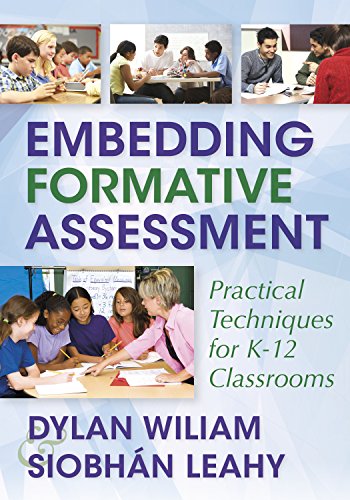
Over the past few weeks, @pamjwilson and I have been reading Embedding Formative Assessment by Wiliam and Leahy.  If you know me at all, you know I love a good #EduRead, but we've been taking this one pretty slow, with a chapter every 2 weeks or so to give us time to research and implement the strategies.  This past weekend was a long weekend for both of us, so we had arranged to read and chat over Chapter 5 - "Feedback that Moves Learning Forward"

Feedback is one of those difficult topics for me.  I know I need to give feedback, but the key is how to give *effective* feedback.  In the chapter, the authors actually share that a lot of the research on feedback isn't very valid due to issues such as a lack of a control group, varying experimental conditions, etc, but there were still some really good nuggets of information, such as this one...

The only thing that matters with feedback is the reaction of the recipient.  No matter how well designed, if the student doesn't act on it, then the feedback was a waste of time.
Wowzers!!!

In other words, feedback is useless UNLESS the student reacts to it and uses it to improve their learning.  I'll admit, that kind of hurts.  I mean, I spend time writing thoughtful comments and hints on their papers, but they aren't taking the same time to read and process those comments. 

But then the sucker punch came....

Don't give feedback unless you allocate class time for students to respond.  If it's worth your time to generate the feedback, it's worth taking instruction time to ensure students respond.
Bingo!!

Do I have systems in place for students to read and process my comments?  Have I set aside class time to model how to interpret and respond to my comments?  And key question - have I taught my students HOW to use the feedback as a tool to improve their learning?

Those were the thoughts rumbling about in my head while I was lesson planning on Monday.  Because of the holiday, this was a short week and I knew my students had a lab report due in Forensics on Tuesday.  Could I figure out a way to implement some of these feedback strategies to help my students write better lab reports?  I knew I wouldn't have time to read and give feedback in a timely manner on 30+ lab reports, so Plan B was born - we could do Peer Reviews! 

In most of our science classes, we use a CER format, which stands for Claims, Evidence, Reasoning.  In general, for Forensics, we use this format more when we have "Casefile" lab where the students have to make a Claim about who did (or didn't) commit the crime, and then back it up by citing their Evidence and then explaining their Reasoning on how they logically came to that conclusion and how they eliminated the other suspects.

We gave them a few minutes at the beginning of class to finish up their CER and refresh on the Casefile from the previous Friday.  Then, we asked them to exchange with another student that was NOT in their lab group.  The student reviewer was to read the CER and provide feedback in terms of a "stars and wishes" - what the original author had done well and what could be improved.  During this time, they were not to talk at all, just read and write.  Then, they returned the paper to the original owner and talked over the feedback and asking clarifying questions.  Finally, we gave the students time to use the peer feedback to revise their CER before turning it in. 

While I have some other strategies from this chapter that I want to try, my biggest take-away is that I need to have a systemic approach to feedback.  I need to spend some time thinking about how to teach my students to read the feedback, but more importantly, how to USE the feedback.  I have to build time into my classes for students to receive feedback and actually implement that feedback to improve their learning.


Wednesday, January 10, 2018

How do you know what they know?

All day today, I kept thinking "I'm totally going to blog tonight... here's idea A, idea B, idea C, etc", but then 4pm came and the thoughts just disappeared or my after-school brain thought "That was a dumb idea... why did I think that would be a good blog post??"  It's so frustrating, but one of my goals this year is to #PushSend, even when I'm struggling.


Over the past few weeks, Pam and I have been slowly reading and discussing Embedding Formative Assessment by Dylan Wiliam and Siobhan Leahy. (Abbreviated EFA2) While there are parts of the book that have been fairly difficult to read, I've also been able to walk away with several usable strategies - and we're only on Chapter 4! :)

This year's theme of "What did you teach? What did they learn?" was inspired by this book and I have really tried to focus on this question each day.  A similar statement from the book was a reminder to stop worrying about the label of "formative assessment" and start thinking about whether your classroom activities will help your students learn more.  As a result of this book, I've really tried to focus on being intentional on "how do I know what they know?"  

In Chapter 3, the authors focus on learning intentions (aka objectives) and success criteria (aka rubrics) and it was this chapter that I've really focused on this week.  

Exit Tickets:  I've renamed my exit tickets as "Daily Reflections".  This week, when students arrived to class on Monday, I had a half sheet in their folder with space for this week's Daily Reflections.  Each day, I have really focused on my theme question of "What did you teach? What did they learn?" to guide me as I write that day's question.  I've tried to be intentional with the Reflection prompt as I think about the day's objective and what I hoped they would be able to do/understand at the end of the lesson.  Today, I tried a suggestion from EFA2 where students generate their own test/quiz questions, hoping to trigger what the authors call the "generation effect", where students remember responses they generate better than responses given to them.  

Success Criteria:  One of the other strategies I tried from Chapter 3 was one about analyzing student work.  The authors spent quite a bit of time in Chapter 3 referencing "success criteria" or rubrics for student work.  In general, I use rubrics for quizzes and tests that mimic the AP Exam style grading, but I remember trying to use an online rubric maker several years ago and I really struggled to understand the difference between "few / some / many" or other descriptors that are often used in those rubrics.  The authors instead suggest  that we should communicate quality work to our students by providing student work samples, not rubrics because rubrics rarely have the same meaning for students as they do for us.  The authors suggested showing examples of various quality to students and having the students give feedback.  For their justification, the authors said there were two main reasons to do this:  (1) students are better about spotting mistakes in the work of others than they are in their own work and (2) when students notice mistakes in the work of others, they are less likely to make the same mistakes in their own work.

I tried this strategy yesterday and today in my Stat class.  I like to start the 2nd semester with simulations because it's kind of fun and eases them back into our course; however, students often struggle with the written portion of a simulation.  I modified a previous AP problem and created two student samples of vastly different quality, and thanks to hubby's help, vastly different handwriting as well!  I asked students to pretend they were the teacher and read the two samples, writing feedback to Student A and Student B regarding what each student did well and what each student needs to improve.  After time to individually assess the student work, I had them share out in their table groups, and then finally as a class share-out of Star and Wish.  Finally, I had them close their eyes and use their fingers to show me what they felt each sample would have scored on the AP Exam on the 0-4 scale.  While I was pleased with the level of engagement each student showed and the quality of their discussions / critiques, the real power of this strategy showed up later in the hour when they had time to work on a problem set.  Many of them referenced the success criteria from the student samples, really putting effort into mimicking the work of the "good" paper and providing each other feedback regarding the quality of their written descriptions.  This was definitely a strategy that I will use again!!


Thursday, January 4, 2018

2018 Classroom Focus

In previous years, I have posted my "mantra" for the year, usually in August.  This year, I didn't post one because honestly I didn't know what my classroom focus would be.  I had plenty of ideas for my personal life, but very little for my professional life.

But, as always, it was @pamjwilson to the rescue.  (If you don't read Pam's blog or follow her on twitter - go do that now.. She's *amazing*)

Over Winter Break, I happened to catch a twitter discussion between Pam and Elissa regarding goals for the new year.  Over the next few days, Pam and I chatted a few times about formative assessment and some of our previous #EduRead books.  One of the books we discussed was Embedding Formative Assessment by Dylan Wiliam, a book that I had started a few years ago, but only read through Chapter 3 before life bogged me down.  :)

Reading this book was already on my to-do list, but after seeing the twitter discussion and Pam's goals, I moved the book to the top of my pile.  

I'm so glad I did, because I finally found my classroom focus for 2018! :)


Such a simple, yet powerful, set of questions to help guide my semester.

What is your classroom focus for 2018?

Saturday, October 7, 2017

Favorite Education Books - #MTBoSSunFun

Just a reminder that the #MTBoS Sunday Funday challenge is back!  This is a weekly blogging prompt that is hosted over at Julie's blog and this week's theme is "Favorite Education Books"

Every week, Julie will push out a new topic, you blog about it and submit your blog post using this Google Form.  On Sunday, there will be a huge list of awesome blogs to go read! :) YAY!

As always, this is a no pressure blogging challenge, so if you don't feel like blogging, that's okay!  I've had many weeks already where I've failed at blogging, so I'm right there with you!  However, this week is one I just couldn't pass up :)

When I first saw this week's prompt, I was like "YAY!!  I've got this one!!!", but as the week went on, I stressed more and more.  I struggle so much with figuring out my "favorite" anything - be it song, movie, book, TV show, etc.  I have so many favorites!  So here goes... my top 5 must-read books for teachers.

Must Read #1 - Make It Stick

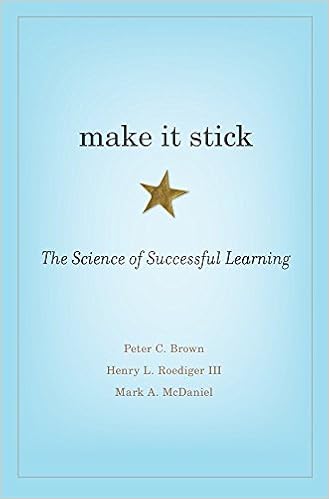
This book was an #EduRead several summers ago.  I first learned about it from Daren Starnes at the AP Statistics Reading when he spoke about it at Best Practices night.  I immediately downloaded it to my Kindle and started reading.  Oh my goodness - game changer!  This book transformed my classroom like no other.  It combined assessment strategies with cognitive psychology with statistical research.  We did a Twitter EduRead on it that summer and this book has been the focus of several talks at various TMCs.  If you want to help your students be active and successful learners, this is the book for you.   Just writing about this book makes me want to read it again! :)  

See the storified Book Chats here


Must Read #2 - Embedded Formative Assessment

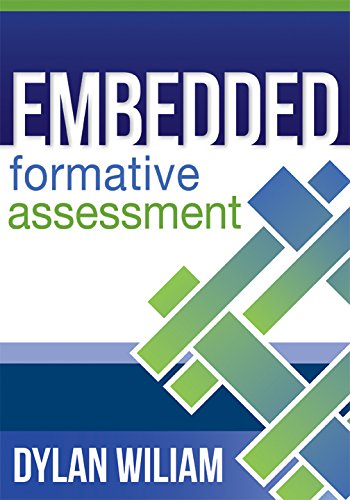
Dylan Wiliam is one of the educational gurus on formative assessment.  This was one of my first Kindle edu-reads and I still refer to my highlights many years later.  Formative assessment has been one of my ongoing professional learning goals and this book is one of the best books out there for formative assessment.  There is a newer version called Embedding Formative Assessment while I own, but haven't fully read - maybe that's a book to tackle soon!  The original EFA (pictured) was one of those books that I recommended over and over and over again to colleagues and administrators.  Man, I wish it were summer so I could have all day to read again! :)

See the storified Book Chats here


Must Read #3 - Mathematical Mindsets

I doubt there is a math teacher out there that is unaware of Jo Boaler and her work with YouCubed, mindset shifts in mathematics, and innovative teaching methods.  This book was one of our EduReads last year - See the Storify on Beth's blog - and once I got into it, there were so many provoking thoughts that I sent a recommendation to our district curriculum director to read this book immediately. Dr. Boaler definitely pushed my thinking on several topics, but she also opened my eyes to some of the damaging methods that are commonplace in k-12 education, specifically in tracking and middle school advancement.  I'm definitely not in the norm at my school with my beliefs on open enrollment and Dr. Boaler's work really pushes the fixed vs growth mindset as it comes to learning mathematics.  


Must Read #4 - Literacy Strategies for Improving Mathematics Instruction

This book was one of our very first Twitter EduReads, back in the summer of 2012, even before we had the #EduRead hashtag and we used different hashtags for each book (this one was the ultra creative #lit4math).  You can read my book reviews here (Chapter 1, Chapter 2, Chapter 3, Chapter 4) and the book chat was Storified over at Pam's blog.  This book is a small one, but it really packs a wallop.  In fact, I can see it sitting under my coffee table right now, ready for me to read it again!  (So.Many.Books!!)  


Must Read #5 - Every Minute Counts


This tiny book (and its sequels - Making Minutes Count Even More and Motivation Counts) were some of the first educational books I owned.  At the time I purchased them (back in the late 90s), I picked them up for about $5 each at my local teacher supply store.  That store has been closed for many years and these books now cost a bit more, but they are still some of my favorites.  For at least the first 10 years of my career, I read and re-read this book series every summer and every time I picked up new nuggets of wisdom.  Each of these booklets contains only about 70 pages, but so many ideas.  Some of ideas are now dated, but practical advice never goes out of style!  The author's down-to-earth writing style and ready-to-use suggestions are what originally drew me to this book and continues to draw me in 20 years later.


What are your must-read books?  Blog about them, tweet about them, share them with us on the #eduread hashtag - I have at least 3 stacks of books to be read, but after writing this post, I just want to go surround myself with some old favorites :)